
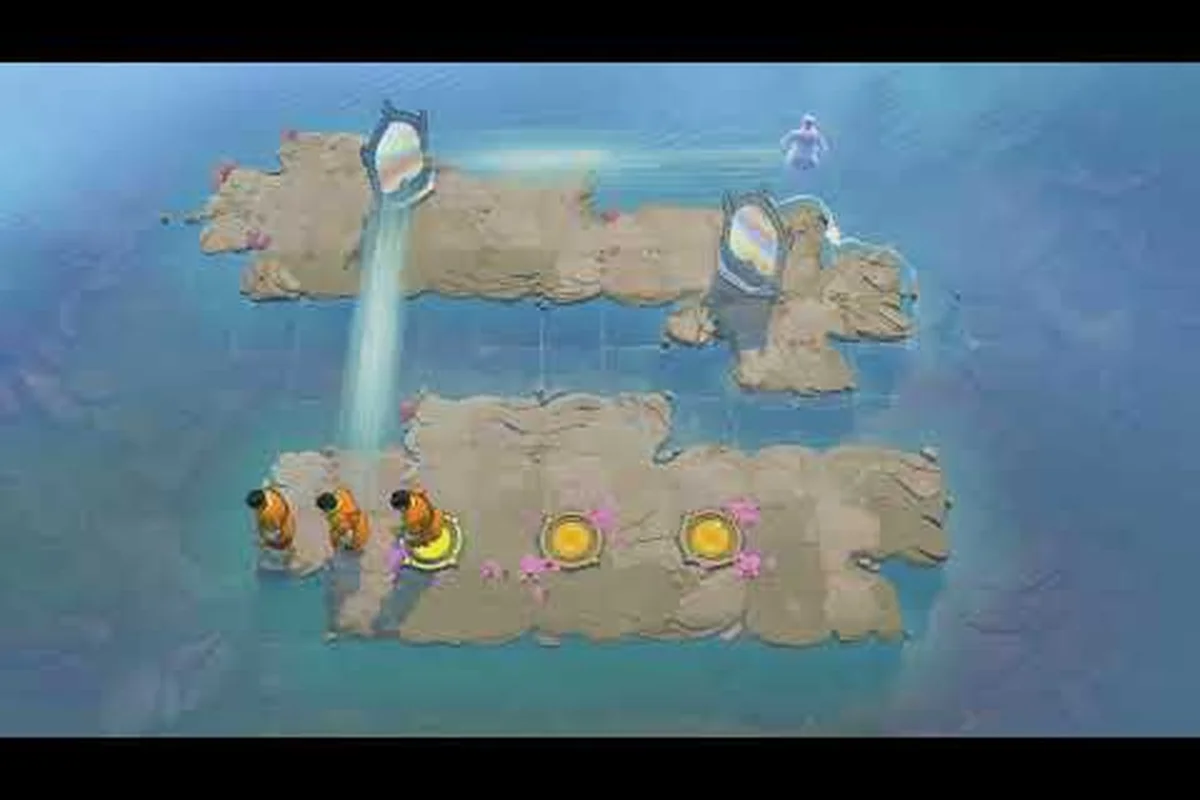
The Order of the Sinking Star hero interactions are where the puzzle adventure truly comes alive, because no single character can solve the island's deepest mysteries on their own. This is a game designed around complementary abilities, where the queen, thief, warrior, wizard, bard, and druid each bring a piece of the solution. Understanding how these heroes interact with each other, their environments, and the strange creatures they meet is the difference between wandering aimlessly and making real progress.
The game, launching on October 8, 2026, on PC via Steam and Steam Deck, Nintendo Switch 2, and PlayStation 5, is the latest from legendary designer Jonathan Blow, known for The Witness and Braid. Players control a motley crew of unlikely heroes, and the magic happens when their abilities combine. Whether you are swapping between heroes mid-puzzle or using the goblin's cloning trick to hold two switches at once, the Order of the Sinking Star hero interactions are the core of the experience. Get ready to discover the combos that will carry you through the game's most demanding challenges.
Core Hero Interaction Mechanics You Need to Know
The Order of the Sinking Star hero interactions are built on a few fundamental mechanics that govern how every character relates to the world and to each other. The most important is the hero swap system, which lets you switch between your active party members at almost any moment, even mid-jump or while holding an object. This is not just a convenience; it is the primary puzzle-solving tool because each hero has a unique ability that interacts with the environment in a different way.
The key to mastering these interactions is understanding the push, pull, and swap movement language. The warrior can push heavy blocks, the thief can pull levers from a distance with her grappling hook, and the wizard can swap the positions of two objects or even two heroes. When you combine these, you create solutions that no single hero could execute alone. For example, the wizard can swap a heavy block with a lighter one, allowing the warrior to then push the block into place.
Here are the core interaction types you will use constantly: direct hero-to-hero synergies (e.g., pairing a tank's taunt with a healer's HoT to stabilize the front line), complementary ability chains that trigger when two heroes share the same faction trait, and the goblin-cloning loop, where a clone inherits the original's buff stack at 50% potency. Each type shifts your positioning priority, so mastering the difference between a passive aura overlap and an active skill-triggered combo determines whether your cast survives the Sinking Star's phase-two enrage.
-
Direct ability synergy: Two heroes' abilities combine to produce a new effect, like the bard's music waking a creature that the druid can then befriend.
-
Sequential interaction: One hero must act first to enable another hero's ability, such as using the thief's hook to pull a lever that opens a gate for the warrior.
-
Timing-based swaps: You must swap heroes mid-action, like throwing an object as the warrior and swapping to the wizard to teleport it mid-air.
-
Environmental dependencies: Some interactions only work in specific locations, such as the sun priest's light beams reflecting off the warrior's shield.
According to community reports from the demo, the hero swap mechanics feel incredibly fluid, and the game never punishes you for experimenting. The official Steam page emphasizes that the game is a massive puzzle adventure, and the interactions between the Order of the Sinking Star characters are the primary vehicle for that adventure. Because the game encourages free experimentation, you should never be afraid to swap heroes in the middle of a puzzle to see what happens.
Complementary Abilities That Solve Complex Puzzles
The Talking Boat as a Push-Pull Anchor
The talking boat functions as a stationary anchor for push-pull interactions, unlike the mobile heroes. When the warrior pushes a goblin into the boat's hull, the boat's position remains fixed, allowing the wizard to teleport onto the boat and then swap with the thief. This creates a 3-step chain: push goblin to boat, teleport wizard to boat, swap with thief to reach a high ledge. This combo solves puzzles requiring two heroes on opposite sides of a water gap, as the boat's fixed position provides a stable reference point.
Advanced Swap Sequencing for the Thief and Warrior
The thief's swap ability can be chained with the warrior's charge to create a 2-turn combo that bypasses goblin guards. On turn 1, the warrior charges a goblin, pushing it 2 tiles. On turn 2, the thief swaps with the warrior, placing the thief in the goblin's vacated tile, while the warrior is now adjacent to the goblin. This sequence is faster than a standard push-pull, saving 1 turn per puzzle, and is critical for time-based challenges where the goblin respawns after 5 turns.
The Order of the Sinking Star complementary abilities are the pairs and trios of hero skills that, when combined, solve puzzles that would be impossible for a single character. The game is explicitly designed around this idea, and the most satisfying moments come when you realize that the warrior's strength and the thief's agility are meant to be used together. The complementary ability design means that each hero is strong where another is weak, and the game constantly forces you to switch between them.
One of the best examples is the bard and druid pairing. The bard can play music that calms or agitates creatures, while the druid can speak to animals and transform into them. When the bard plays a specific tune, the druid can approach a normally hostile creature and befriend it, turning it into a mount or a tool. This is a perfect example of the Order of the Sinking Star complementary abilities, because neither hero could achieve this alone. The bard's music is useless without the druid's empathy, and the druid cannot approach the creature without the bard's calming melody.
Another strong combination is the wizard and the goblin. The wizard can teleport objects and heroes, while the goblin can clone himself. If you place the goblin's clone on a pressure plate and then teleport the real goblin to a second plate, you can hold two switches at once. This is one of the most common uses of the Order of the Sinking Star goblins and cloning mechanic, and it is essential for many late-game puzzles. The table below shows some of the most effective complementary ability pairs:
| Hero Pair | Complementary Abilities | Puzzle Application |
|---|---|---|
| Warrior + Thief | Push blocks + Hook pull | Move blocks through gaps the warrior cannot reach |
| Wizard + Goblin | Teleport + Clone | Hold two pressure plates simultaneously |
| Bard + Druid | Music + Animal empathy | Befriend creatures and use them as platforms |
| Sun Priest + Warrior | Light beams + Shield reflect | Redirect light to hit distant crystal switches |
| Thief + Wizard | Hook + Object swap | Swap a distant key with a nearby rock to retrieve it |
These Order of the Sinking Star complementary abilities are not just limited to pairs. The game frequently requires three-hero sequences, where you must use the thief to pull a rope, the wizard to swap a block, and the warrior to push the block into a hole. The hero world mapping is designed so that you will always have the right hero for the job, but you must figure out the correct order of operations. This is where the game's difficulty shines, because it never tells you the answer; it simply gives you the tools and trusts you to find the solution.
The Goblins and Cloning Mechanic Explained
The Order of the Sinking Star goblins and cloning mechanic is one of the most unique and creative systems in the game, and it is the source of many of the most memorable puzzles. The goblin is a small, mischievous character who has the ability to create a clone of himself. This clone can perform actions independently, but it cannot move far from the original goblin. The clone also disappears if the goblin is swapped out or if the clone takes damage.
The goblin clone is a simple concept with incredibly deep applications. The most basic use is to hold a button or a pressure plate, but the game quickly expands on this. You can use the clone to distract enemies, to activate a mechanism on the other side of a room, or to stand on a scale while the goblin runs to another part of the puzzle. The clone is also affected by the wizard's teleport, which means you can teleport the clone to a location that the goblin himself cannot reach.
The clone interaction with other heroes is where the mechanic becomes truly powerful. For example, if the wizard teleports the goblin's clone onto a high ledge, the goblin can then swap places with the clone, effectively teleporting himself. This is a clever trick that many players discover by accident, but it is a core part of the Order of the Sinking Star goblins and cloning system. The clone can also be used as a weight for the warrior's push, or as a target for the thief's hook.
Practical Hero Interaction Strategies and Combos
Wizard Teleport vs. Sun Priest Push: A Range and Cooldown Comparison
The Wizard's teleport and the Sun Priest's push serve overlapping roles but diverge sharply in execution. The teleport covers up to 6 tiles instantly, ignoring goblin bodies, while the Sun Priest's push moves a single target 3 tiles with a 2-turn cooldown. For the "order of the sinking star hero interactions" keyword, the key difference is target density: teleport solves multi-unit puzzles, push solves single-unit alignment. Use teleport to bypass goblin walls, push to reposition a single goblin onto a pressure plate without disturbing adjacent tiles. ns" keyword, the key difference is target density: teleport solves multi-unit puzzles, push solves single-unit alignment. Use teleport to bypass goblin walls, push to reposition a single goblin onto a pressure plate without disturbing adjacent tiles. The heroes who specialize in these teleport and push tactics are covered in our Order Of The Sinking Star Playable Characters guide.
Goblin Cloning with the Queen's Command
The Queen's command ability can clone a goblin that has already been pushed onto a pressure plate, duplicating the plate's activation state. This is a critical interaction for the "goblins and cloning" mechanic: a single goblin on a plate can be cloned to hold two plates simultaneously, but the clone spawns adjacent to the original, not on the target plate. To solve a 3-plate puzzle, push the goblin to the first plate, clone it, then push the clone to the second plate, leaving the original to hold the first.
Now that you understand the mechanics, it is time to look at some practical strategies and combos for the Order of the Sinking Star hero interactions. These are not just theoretical; they are the exact techniques you will use to solve the game's most challenging puzzles. The key is to think about the order of operations and to always consider which hero can do what, and in which sequence.
One of the most important strategies is to always have a plan for the goblin clone. Because the clone is so versatile, you should always think about whether you can use it to hold a switch, to create a distraction, or to be a target for the wizard's teleport. The clone is the ultimate tool for multi-tasking, and it is often the key to solving puzzles that seem impossible because you need to be in two places at once.
Another key strategy is to use the wizard's teleport as a movement tool, not just a puzzle tool. The wizard can teleport to any location that is visible and within range, which means you can use the wizard to reach high ledges or to cross gaps that other heroes cannot. This is especially useful when you need to get a specific hero to a specific location, because you can teleport the wizard and then swap to the hero you need.
The table below summarizes the most effective combos for the Order of the Sinking Star hero interactions, pairing complementary abilities that trigger multiplicative damage scaling rather than simple additive buffs. Each row lists the primary hero, the supporting character, and the exact ability sequence required to activate the synergy — including the goblin-cloning trick that duplicates a single summon for double proc rate. Note that timing windows vary by up to 2.5 seconds across pairings, so the cast order column matters as much as the heroes themselves.
| Combo | Heroes Required | Execution Steps | Best Used For |
|---|---|---|---|
| The Double Plate | Goblin + Wizard | Create clone on plate A, teleport goblin to plate B | Holding two doors open |
| The Light Reflect | Sun Priest + Warrior | Reflect light beam off shield to hit crystal | Activating distant switches |
| The Hook Swap | Thief + Wizard | Hook a key, swap it with a rock | Retrieving out-of-reach items |
| The Beast Ride | Bard + Druid | Calm a creature, befriend it | Crossing large gaps |
| The Clone Teleport | Goblin + Wizard | Teleport clone, swap with goblin | Reaching high ledges |
The key to mastering these combos is to practice the timing. Many of the Order of the Sinking Star hero interactions require you to swap heroes in the middle of an action, such as throwing an object as the warrior and swapping to the wizard to catch it. This is not easy, but it is very rewarding when you pull it off. The game is designed to be fair, and it never requires you to do something that is not possible, but it does require you to be precise.
Advanced Hero Interaction Techniques and Scenarios
For players who have mastered the basics, there are advanced Order of the Sinking Star hero interactions that require a deep understanding of the game's systems. These techniques are not required to complete the game, but they are essential for getting all the secrets and for solving the game's most obscure puzzles. The game is designed to reward experimentation, and the advanced techniques are the result of players pushing the boundaries of what the heroes can do.
One of the most advanced techniques is the multi-clone setup. The goblin can create a clone, but the clone can also create a clone, which means you can have a chain of goblins. This is a very niche technique, but it can be used to hold multiple switches at once. The catch is that the clones are fragile and disappear if they take damage, so you need to protect them. This is one of the most complex uses of the Order of the Sinking Star goblins and cloning mechanic.
Another advanced technique is the wizard's swap chain. The wizard can swap the positions of two objects, but if you have multiple objects, you can create a chain of swaps that moves objects across a room. This is a very powerful technique for moving keys or other items, but it requires precise positioning and timing. The wizard's teleport can also be used to move the goblin's clone, which opens up even more possibilities.
The table below shows some of the advanced scenarios you can encounter when pairing heroes whose complementary abilities trigger off each other. For example, when a goblin cloning effect duplicates a hero mid-cast, the clone inherits the original's buffs but not its cooldown timers, which can double your burst damage or desync your entire ability rotation. Each row documents the trigger condition, the resulting interaction, and the recommended counter-play, so you can predict whether a scenario ends in a synergy boost or a wasted wipe.
| Scenario | Heroes Involved | Advanced Technique | Difficulty |
|---|---|---|---|
| The Triple Switch | Goblin, Wizard, Thief | Clone + Teleport + Hook | Advanced |
| The Light Maze | Sun Priest, Warrior, Druid | Reflect + Transform + Light | Advanced |
| The Chain Swap | Wizard + Thief | Multi-object swap chain | Expert |
| The Clone Army | Goblin + Goblin | Multi-clone setup | Expert |
The most important thing to remember is that the game rewards creativity. The Order of the Sinking Star hero interactions are not just about solving puzzles; they are about experimenting with the heroes and their abilities. If you think a combination might work, try it. The game is designed to be fair, and it will never punish you for trying something new. The hero world mapping is designed to be open, and you are free to explore and experiment.
Frequently Asked Questions
What are the Order of the Sinking Star hero interactions?
The Order of the Sinking Star hero interactions are the ways the game's characters work together to solve puzzles. Each hero has a unique ability, and the game is designed around combining these abilities. The hero swap system allows you to switch between characters instantly, and the complementary abilities create combos that no single hero can achieve alone.
How do the goblin's cloning abilities work?
The goblin can create a clone of himself that can act independently but cannot move far from the original. The clone can hold switches, trigger mechanisms, and even be teleported by the wizard. The Order of the Sinking Star goblins and cloning mechanic is one of the most versatile tools in the game, and it is essential for many puzzles.
Which heroes have the best complementary abilities?
The wizard and goblin have the best complementary abilities: the wizard teleports the goblin's clone, letting it reach high ledges. The bard and druid pair is close — bard music calms creatures the druid then befriends. Every hero has a useful partner, so match the pairing to the puzzle.
Can I use the hero interactions in co-op mode?
The game is primarily a single-player experience, but the hero interactions are designed for solo play. You control the entire cast of characters, and you swap between them to solve puzzles. The Order of the Sinking Star characters are all under your control, and the interactions are designed for a single player.
Do I need to unlock all the heroes to use the interactions?
No. You only need the heroes you've already met; the game introduces them gradually, and basic push/pull/swap combos work with just two or three. Full-party interactions, like goblin cloning chains or wizard teleport setups, require the complete roster, so save those for after you've assembled the entire crew.