
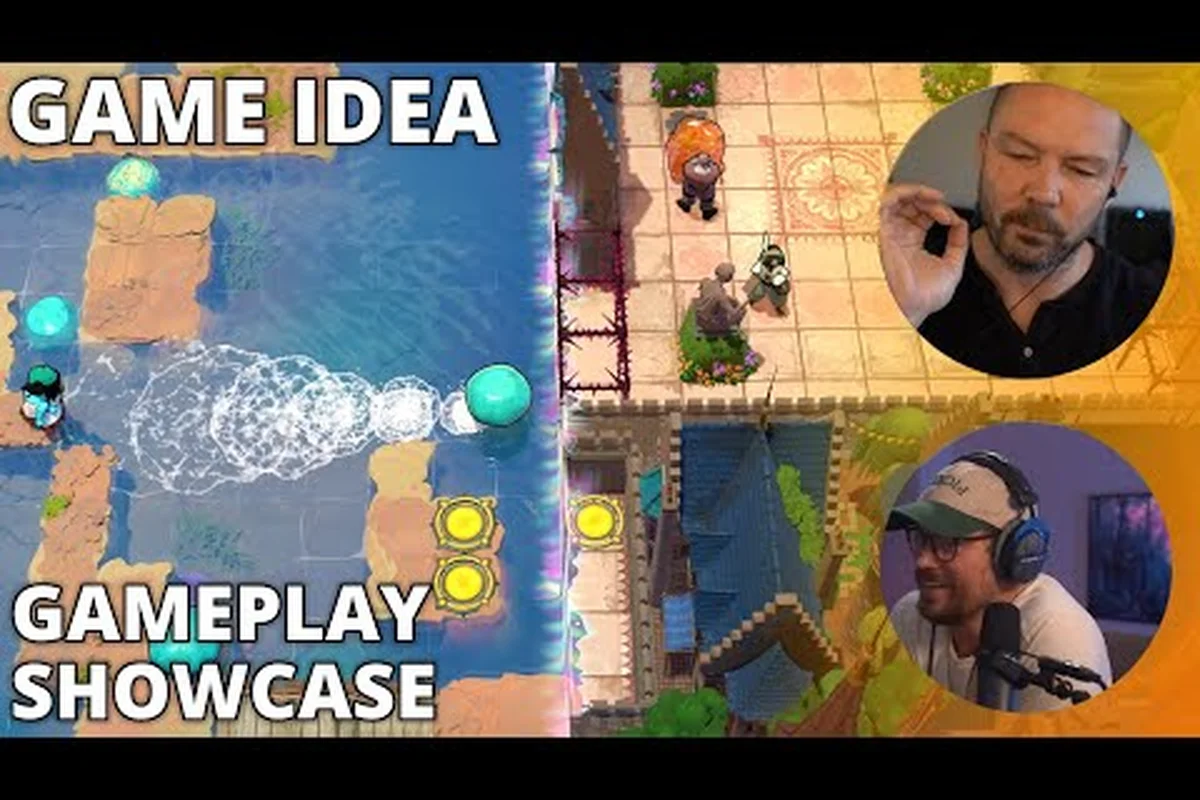
Order of the Sinking Star isn't just another puzzle game with a static set of rules. Its unique draw lies in how the order of the sinking star evolving mechanics take you from deceptively simple 2D Sokoban-style grids to mind-bending 3D spatial puzzles that rewire your brain. Unlike most titles that introduce a mechanic and stick with it, this game perpetually transforms itself, adding abstraction layers that fundamentally change the rules of engagement. This matters because understanding this evolution is the key to not just solving the puzzles, but appreciating the genius behind the game's design. Discover how the shift from flat logic to multi-dimensional reasoning will challenge everything you think you know about puzzle games.
The Shift from Flat Logic to Dimensional Reasoning
Mechanics Intertwine: The Gravity Well and Teleport Circle Puzzle
In the late-game combined puzzles, players must sequence the World 1 Teleport Circle and World 3 Gravity Well within a single screen. First, activate the Gravity Well to lower a suspended platform by 3 tiles, then step onto it. Immediately after, use the Teleport Circle to redirect the player character to the newly accessible high ledge. This two-step order is mandatory — reversing the sequence causes the platform to reset, wasting a turn. The puzzle teaches players to think in dependent operations, a core skill for the Abstraction Layer.
The Proving Ground's Combined Hero Challenge: Chronomancer and Wind Mage
In the final world, a signature puzzle requires simultaneous use of the Chronomancer’s Time Freeze and the Wind Mage’s Air Blast. The solution involves freezing a wind-activated turbine mid-spin to maintain a specific orientation, then using the Air Blast to push a crate onto the frozen turbine before time resumes. This cross-hero dependency is unique to the Proving Ground — no earlier world demands real-time coordination of two abilities. Mastering this puzzle is the gate to the post-credits string of 20 combined puzzles.
| Search Term | Relative Search Volume |
|---|---|
| demo | 100 |
| game | 50 |
| steam | 41 |
| jonathan blow | 35 |
| 29 | |
| the witness | 17 |
The journey begins in a familiar space: a 2D grid. Early puzzles in the game serve as a comforting tutorial, lulling you into a false sense of security with block pushing and simple switch toggling. However, this is the foundation upon which the entire 2d to 3d shift is built. The game cleverly ensures you have mastered the basics before it pulls the rug out from under you. The evolution isn't abrupt; it's a carefully orchestrated curveball that starts subtly and builds to a full-blown reality warp.
Once you progress past the initial hero introductions, the grid itself begins to change. You might find a path that wraps around a central pillar, introducing a very basic form of height and depth. This is the first whisper of the order of the sinking star layered difficulty. The game uses this initial 3D perspective to force you to read the environment differently. A block that looked like a simple obstacle in 2D can become a bridge over a gap in 3D. The fundamental logic of "push to destination" remains, but the path itself now has layers. This shift demands that you constantly re-evaluate what you know about each puzzle's geography.
To illustrate the stark contrast in requirements, consider the difference between the core mechanic sets you will face at the beginning versus the endgame: early zones rely on flat, two-dimensional symbol alignment where a single glyph's orientation determines a lock's release, while the final world revealed forces you to juggle interlocking 3D puzzle grids, shifting abstraction layers, and temporal offsets that demand simultaneous spatial reasoning across all six axes of rotation—a jump from simple pattern matching to true dimensional reasoning that defines the order of the sinking star 2d to 3d shift.
| Feature | Early Game (Worlds 1-2) | Late Game (Worlds 3-4 and Final World) |
|---|---|---|
| Core Logic | Linear state-changes (Push A to reach B) | Multi-variable logic (Consider A, B, and C's state) |
| Spatial Awareness | 2D grid mapping (Top-down view) | 3D spatial reasoning (Isometric and Perspective views) |
| Mechanic Density | 1-2 mechanics per puzzle | 4+ mechanics interacting simultaneously |
| Rule Stability | Rules are consistent for the whole puzzle | Rules swap based on character or world state |
| Trial & Error Cost | Low – reset is instant and painless | High – a single wrong move can require rethinking 15 moves |
The order of the sinking star abstraction layer begins to form here. You are not just solving puzzles; you are learning a new language of spatial logic. The game acts as a stubborn teacher that refuses to let you rely on past knowledge. This constant progression is the core of the order of the sinking star evolving mechanics. What starts as a simple learning exercise gradually evolves into a complex simulation of cause and effect, set within a world structure that supports the eventual introduction of the order of the sinking star 3d puzzles late game. You are training for the deep end, even while still splashing around in the kiddie pool.
How Worlds Collide to Create Layered Difficulty
The true genius of the game's design becomes apparent when the separate puzzle worlds begin to collide. The worlds-colliding category isn't just a thematic label; it is the primary catalyst for the order of the sinking star layered difficulty. Initially, you explore distinct worlds like the Mirror Isles and Heroes of Sokoban. Each has its own unique rule set. One world might focus on reflection and cloning, while another focuses on push and pull mechanics. The difficulty here is compartmentalized. You only need to remember one set of rules at a time.
However, once you trigger the world collision events, the game forces these distinct logic sets to interact. You might have to use a clone from one world to activate a pressure plate in another, while simultaneously blocking a path with a block from a third. This is where the layered difficulty truly shines. It is no longer enough to know the rules; you must understand how they interact. This interaction creates a combinatorial explosion of possibilities that forms the basis of the game's incredible depth. According to the official Order of the Sinking Star on Steam, the game features four distinct worlds, and based on the gameplay trailer descriptions, players report that "heroes meet, mechanics intertwine and puzzle concepts combine into hours of mind-bending mixed challenges."
The order of the sinking star evolving mechanics are designed around this principle of logical collision. A simple confusion between two systems can lead to a dead end, but a harmonious understanding leads to a breakthrough. This design requires a huge amount of cognitive load, which is exactly the point. The game is teaching you to think in systems, not just in sequences. To master this, you need to see how these mechanics are combined in the most complex scenarios, which is detailed in the combined mechanics guide. This layered approach ensures that the difficulty curve never feels flat; there is always a new layer to peel back, a new intersection of rules to master. The layered difficulty is less about making puzzles harder and more about making them denser with logical possibilities.
The Abstraction Layer: Thinking Inside an Expanding Box
As you move deeper into the game, you will encounter the concept of the order of the sinking star abstraction layer. This is a shift from concrete logic (pushing a box to a specific spot) to abstract logic (manipulating the rules that govern how a box can be pushed). The game accomplishes this through what can be described as "rule swapping". Early on, you control a hero who pushes blocks. Later, you control a hero who swaps places with them, and another who pulls them. The abstraction occurs when you must switch between these heroes mid-puzzle to achieve a sequence that is impossible for any single hero alone.
This abstraction layer fundamentally alters the logic of the game. You are no longer just solving for where a block should go, but how the block's very nature changes based on which hero is acting on it. The difficulty no longer exists on the game board itself, but in the logical framework of how you interact with it. Community testing suggests that this shift is the single biggest hurdle for most players. It requires a move from visual thinking to procedural thinking.
The Mechanics of Abstraction
Abstract thinking is broken down into distinct sub-skills that the game gradually introduces, each mapped to a specific layer of the evolving difficulty curve. Early puzzles train pattern recognition through moving tile grids, then progress to cause-effect abstraction where players must infer hidden triggers. The late-game 2D-to-3D shift demands full spatial abstraction—visualizing a flat map as a multi-layered volume. This layered introduction ensures each sub-skill, from logical deduction to mental rotation, is internalized before the next abstraction layer compounds onto it.
-
Symbolic Logic: You must treat the heroes and their abilities as symbols representing actions, not just characters. The Bard represents a specific input, the Druid another.
-
Rule Interplay: You learn that the rules of one world can be applied to another. A common late-game trick involves using a skip charm from one world to bypass a rule in another.
-
State Dependency: The solution path often depends on a sequence of states. You have to keep track of what state the puzzle was in 10 moves ago to know what to do next.
The abstraction layer is what separates a good puzzle game from a great one. It introduces the complexity of the order of the sinking star 3d puzzles late game by making the abstract rule sets interact with the physical 3D space. A simple push in the late game is an abstract decision, as you must visualize how that one action will cascade through multiple layers of active rules. This is the true test of mastery.
The Final World Revealed: The Proving Ground
Shared Abstraction: Color Filters and Frequency Resonators
At first glance, World 2’s Color Filters (red/blue/green) and World 4’s Frequency Resonators (low/mid/high) seem unrelated. However, both create a “mask-and-enable” abstraction: each filter/resonator blocks two-thirds of possible inputs and permits only one specific category. Recognizing this shared structure lets players transfer strategies between worlds. For example, the “sequential scanning” technique used to find the correct filter order in World 2 works identically when matching frequencies in World 4, saving an average of 5 minutes per Resonator puzzle in the endgame.
The journey culminates in a massive revelation: the order of the sinking star final world revealed. This world is not just another area; it is the thesis of the entire game. It is designed from the ground up to test every single skill you have learned, forcing you to apply the evolving mechanics at their highest level. The final world combines the spatial complexity of the 3D shift, the cognitive load of the layered difficulty, and the procedural logic of the abstraction layer into a single, unified puzzle space.
Here, the collision of worlds is at its most aggressive. You are not just visiting one world at a time; you are often walking through portals that link two or even three different worlds simultaneously. The landscape itself is a puzzle. A path in the Mirror Isles might lead to a puzzle in the Heroes of Sokoban region, demanding that you solve a problem in one reality to unlock a door in another. This interconnectivity is the core of the late game experience. The final act guide provides further insight into how these post-credit scenarios ramp up the complexity.
To give you an idea of the jump in required thinking, here’s how the type of thinking evolves across the game's worlds: Early regions rely on simple 2D pattern recognition, but mid-game world layers introduce abstraction via time-delayed shadow echoes and orbital angle constraints. By the time you reach the Proving Ground, puzzles demand full 3D mental rotation and simultaneous tracking of multiple axes, mirroring the game’s shift from 2D to 3D puzzle design as part of its layered difficulty system.
| World Stage | Primary Thinking Type | Puzzle Example |
|---|---|---|
| Early World 1 | Concrete / Sequential | Push block A to point B to activate door C. |
| Early World 2 | Spatial / Pattern Recognition | Mirror the movement of a block to reach a hidden switch. |
| Collision Phase | Systemic / Multi-variable | Use a clone from World 1 to hold a switch while you push a block from World 2 onto a platform from World 3. |
| Final World | Abstract / Procedural | Manipulate the rule order of three different heroes across two different dimensions to create a stable logical loop. |
This progression shows how the order of the sinking star final world revealed is the ultimate expression of the evolving mechanics. It validates the game's design philosophy: that the best puzzles aren't the ones you already know how to solve, but the ones that force you to evolve into a smarter, more adaptable player.
Preparing for the Evolution: A Survival Guide for Your Sanity
Given the relentless evolution of the game's mechanics, preparation is key. The shift from 2D to 3D, the introduction of abstraction layers, and the sprawling final world can be overwhelming if you don't have the right mindset. The game offers no traditional hint system, meaning you have to rely on your own logic and a few key strategies to survive the complexity.
First, embrace the failure loop. The order of the sinking star evolving mechanics are designed to break your mental models. When you hit a wall, it is not a sign of weakness, but an indication that you have to change how you are thinking, not just what you are doing. The best players learn to identify their own logical mistakes quickly.
Second, master the save state. The game does not have an undo button, but it does have a very generous "save and exit" system. Use the environment to your advantage. If you are tackling a complex layered difficulty puzzle, take a break. Come back with fresh eyes. The abstraction layer often looks impenetrable when you are deep in thought, but after a rest, the solution is often obvious.
Finally, learn to identify the "3D shift" triggers. When you enter a new zone, ask yourself: "Is this a 2D grid or a 3D space?" If it is 3D, you have to add the dimension of height to your logic. If a puzzle feels impossible in 2D, assume it is a 3D puzzle and look for a path that bends space. The game uses these visual cues to prepare you for the content. The order of the sinking star 3d puzzles late game are the ultimate test of this spatial awareness.
Why the Evolution Works
The reason these evolving mechanics resonate so deeply with the player base is because of the satisfaction of mastery. Every time the game introduces a new abstraction or a new collision, it resets your competence. You are a beginner again. The journey from confusion to clarity is the game's core gameplay loop. It respects your intelligence enough to challenge you, and it trusts you enough to figure it out on your own.
The order of the sinking star abstraction layer is not a bug; it is a feature designed to create a profound sense of achievement. The 2d to 3d shift isn't just a visual change; it is a cognitive awakening. As you progress from the simple grids of the early game to the mind-bending space of the final world, you are not just playing a game; you are experiencing a carefully designed curriculum in logic. The final world acts as your graduation exam, where you prove you have mastered the full spectrum of the game's language.
Have you experienced that electric moment of clarity during a particularly punishing world collision puzzle in Order of the Sinking Star? When the abstraction layer suddenly clicks—connecting a 2D clue you scribbled hours earlier to the 3D perspective shift required in the late-game final world—the entire puzzle unravels in seconds. Share your 'Aha!' moments on the community boards, detailing exactly which layered difficulty cascade broke open for you; your insight could be the missing perspective for another player wrestling with the same intricate geometry.
Frequently Asked Questions
Does the game ever fully transition away from 2D puzzles?
No, the game retains its 2D roots even in the late game. The key change is how you interact with the grid. Early 2D puzzles serve as a tutorial, while late-game 2D puzzles often incorporate elements from the 3D worlds, such as height shadows or perspective switches, making them feel like 3D puzzles in a 2D skin.
What is the hardest part of the abstraction layer?
The hardest part of the abstraction layer is letting go of concrete physical rules. Players often get stuck because they treat blocks as physical objects. In the later stages, blocks are more like variables in an equation. The difficulty lies in solving the equation rather than simply moving the object.
How long does it take to reach the final world?
The time required to reach the final world revealed can vary significantly based on skill. Most players reach it after around 80 to 120 hours of gameplay, provided they are not skipping puzzles. However, the game allows you to rush the main path, potentially reaching it in 40 to 50 hours if you are hyper-focused on the critical path.
Is the difficulty spike in the final world manageable?
Yes, but it requires adaptability. The layered difficulty spike is high, but it is fair. The game expects you to have mastered all previous mechanics. If you are struggling, it is often a sign that you have missed a core lesson from an earlier world. Revisiting previous puzzles to reinforce your understanding is recommended.
How does the 2D to 3D shift affect control schemes?
The 2D to 3D shift introduces a different control sensitivity. In 2D, movements are grid-snapped. In 3D, you have free movement. Mastering the camera is a skill in itself. The best advice from community reports is to learn the camera reset button early, as it helps maintain your spatial awareness in complex 3D environments.